Commonly used terms by collectors
Adhesive Sticker Sheet – This refers to a paper backed sheet with pre-cut designs. The pre-cut designs have an adhesive applied to their underside and when pulled away from the backing, they can be directly applied.
Blister Pack – This refers to the packaging the majority of Redlines were sold in. A blister pack consists of a paper backing with colorful artwork and the Hot Wheels logo on the front and the listing of available cars on the back while a clear plastic bubble, referred to as a blister, is secured to the front enclosing the car.
Casting – Refers to the actual Hot Wheels model itself.
Crumbler – There was a brief period around 1971 when the composition of metal used was of lesser quality or of a poor mixture which led to what are called by collectors as “crumblers.” These “crumblers” are just that – the base or body crumbles due to moisture or humidity that causes the metal to swell through minute fractures ultimately reducing it to a pile of rubble. For instance, the body can be pristine without any flaws while the base has swelled or completely crumbled into many pieces. Unfortunately, there is no way to cease the process once it has begun and “crumblers” have ultimately no value. It is also worth mentioning that this condition can exist with castings still sealed in their blister pack.
Base – The base of the car is simply the chassis. It sometimes provides characteristics of early or late run production but more importantly supplies the copyright and patent information as well as the casting name and its country of origin. For castings introduced during the years of 1968 and 1969, the U.S. base is less detailed then the Hong Kong base and the U.S. base does not have four open square cut outs revealing part of the suspension whereas the Hong Kong base does. For castings introduced in 1970 and lasting through to 1972, the U.S. and Hong Kong bases were similar, lacking detail on both, but were still stamped with their country of origin, casting name, and copyright and patent. Remember, the year stamped on the base corresponds to the copyright, not the year of manufacture - typically one year before release.
Filler – A casting that is in either poor condition or has been repainted which will serve as a space holder until a better example is found.
Hybrid – This term is used to describe a casting that has been produced with both U.S. and Hong Kong parts. The number of parts used from one origin versus the other can vary drastically from one to many. A great example is the Custom Barracuda where you can have a U.S. made body, interior and hood and the base, wheels and glass are Hong Kong parts. There are several hybrid castings but the most familiar are the early run Custom Camaro, later run Custom Barracuda and Sand Crab.
Over Chrome – This refers to a Club Kit car that has Spectraflame paint applied over the chrome.
Power Bulges – This term refers to the hood scoops or air vents that were cast onto hoods and engine covers.
Peppering – This refers to fine particles found under the paint that gives the finish a rough texture that can be seen and or felt and usually results in tiny black specs resembling pepper.
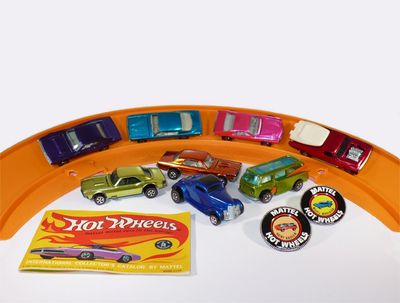
Redline – This refers to the red line around the perimeter of all wheels produced in 1968 through 1977. This red line made Hot Wheels stand out from the crowd and is why collectors call these cars “Redlines.”
Tampo – This refers to the painted designs that are applied by a pad press to particular castings. The term was derived from the manufacture of the equipment used by Mattel for this particular process.
Toning – Also known as mottling, refers to wisps, small to medium dark spots or larger dark patches found under the paint leaving an uneven hue and often can be distracting. Toning can affect the entire car or just certain parts like the hood or rumble seat. In extreme cases, toning can be down right unsightly. It is said toning can be caused by imperfections in materials such as the zinc-plated metal itself, or improperly polishing the casting during preparation prior to painting. Furthermore, it has been suspected that environment and storage conditions such as UV rays and moisture have contributed to the cause or acceleration of toning.
Water Slide Decal Sheet – This refers to a paper backed sheet with a very thin clear top that would have sponsor logos or other designs such as flowers printed on it. When this sheet is submerged in water, the logos or designs will slide off from the paper backing and then can be applied.
ZAMAC – This is an acronym for zink, aluminum, metal, alloy, casting and is the metal most commonly used in die casting and is what our Redlines are made of.