SPOTTING PROTOTYPE AND PREPRODUCTION CASTINGS
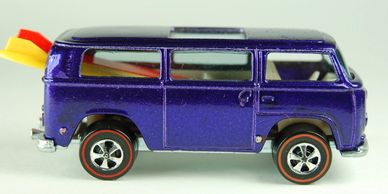
The vast majority of castings in circulation and in our very own collections are just regular, run-of-the-mill production castings. Even still, they are highly prized and cherished. There are however very few “early” castings, and while very rare, they can be found in some of our fellow collectors’ display case. Interestingly enough, it is certain there are still more of these “early” castings out there, perhaps in an old shoe box tucked away in the closet, or wrapped in tissue sitting in one’s Collector’s Race Case just waiting to be discovered. These early castings that I am referring to are prototype and preproduction castings.
Unfortunately most collectors are unsure of what the differences are between a prototype, preproduction and production casting. Let alone they don’t even know what to look for. Over the many years of collecting, although never documented before, several traits and cues have been identified that depict prototypes and preproduction castings. The information that follows should help you in spotting a prototype or preproduction casting and further your knowledge as to the differences between these and production castings.
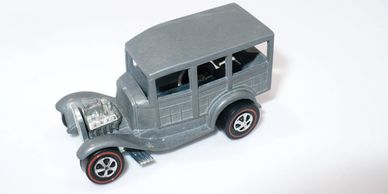
The foremost cue of a prototype would be a raw ZAMAC casting. This is a casting that is unpainted metal and may or may not be complete with interior, glass and a base. All designs required this prototype stage to see how parts fit together and to see if there should be changes made before its release to production.
An additional primary cue of a prototype would be a car made of resign. There were instances when time was a factor and an actual metal casting was not available. So the need for a physical example brought about a casting made of resign which could then be used for let’s say photos in a catalog. If you look through some of the earlier Hot Wheels catalogs you can spot these resign castings. They were hand painted and usually have black painted windows which helps identify them more easily. A few or these resign pieces have been found, but unfortunately most have not.
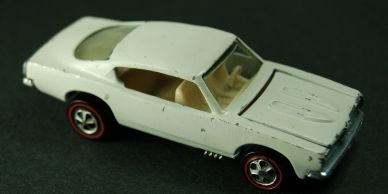
Another significant prototype cue for a Spectraflame era piece would be one that is painted enamel. These enamel painted cars are believed to be among the earliest fully assembled Hot Wheels cars known. The understanding behind these early enamel painted pieces was to check for casting flaws and irregularities. The majority are painted either white or black enamel but a few have been found in red and yellow.
Being Mattel used facilities both in the U.S. and in Hong Kong for the first few years, prototypes usually have a combination of Hong Kong and U.S. parts such as interiors, windows and wheels. For example, the use of early U.S. chrome wheels on a Hong Kong casting may perhaps be a cue. These very early U.S. wheels are heavily chromed and have only been found on prototypes, painted over chrome sample cars (we will get to these a little later) and early production run painted tail U.S. castings including the Custom Camaro and Custom Mustang. Another cue would be the use of a Hong Kong interior used in an otherwise all U.S. made car.
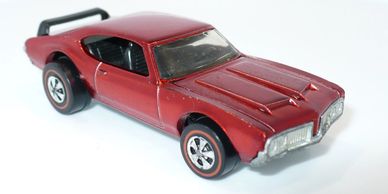
An additional cue to look for is the color of the interior. In most cases, a prototype will have a black interior. For example, a black interior found in a Spectraflame orange Hong Kong Custom Cougar would be a prototype being the production run only had a brownish orange, white, light or dark brown colored interior. This black interior is consistent with other known prototypes of the same period including a raw ZAMAC Custom Camaro, antifreeze Spectraflame Camaro and red and gold Spectraflame open hood scoop Custom Mustangs. In keeping with interior color as being a cue, it is believed that the Seasider found only in Spectraflame orange with white interior is a prototype. The reasons being are none have been found packaged indicating an early run and all other Spectraflame colored Seasiders have just a black interior. In addition, it is also believed that the Olds 442 only in Spectraflame red with black interior is another prototype casting. Again being none have been found packaged indicating an early run and all other Spectraflame colored Olds 442s have just a white interior.
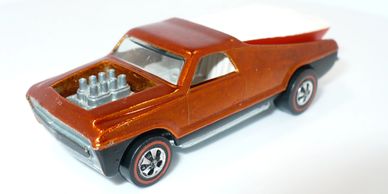
A further prominent cue would be the omission of the words patent pending stamped on the base. This is attributed to either the words weren’t necessary because these were not production run castings or the need for the words came later on during mass production. This trait in addition to the black interior is found on prototype Custom Camaros, Custom Cougars and Custom Mustangs.
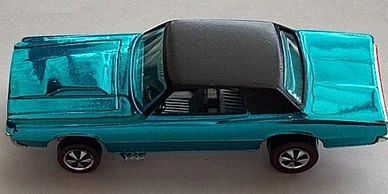
A very distinct cue of a preproduction casting is one that is painted over chrome. A painted over chrome car is just that; before being painted it was plated with chrome so that the color would be as reflective as it could be. It is believed that these painted over chrome cars were made specifically for photo shoots, commercials and also to sample to Mattel executives and sales staff. There is no toning or darkening on a painted over chrome car and when you see one, you know from the glow!

Some particular traits found with Hong Kong prototype castings is the use of clear window glass, not blue which is typical of all production run Hong Kong cars. Examples are the prototype Spoilers including the Heavy Chevy, Nitty Gritty Kitty and TNT Bird to name a few. These particular prototypes did not have any grille or tail light paint and there were no stripes or decals applied. Also, the TNT Bird actually had a larger front air damn then the production run casting. In addition, smoked window glass was used on some other Hong Kong prototype or preproduction castings such as the Maserati Mistral and Mercedes-Benz 280SL.
Noteworthy traits found on prototype Grand Prix cars are that they happen to have a clear windscreen and white interior where the production castings have a blue windscreen and tan or dark brown interior.
There are some castings that have been found that are usually one of a kind, but at times there are a couple which are similar. Some are completely painted and assembled while others may not be painted or parts not fastened together. These particular castings are not prototypes, preproduction or even true production pieces. So, what are they then? They happen to be what collectors have coined “Lunch Time Cars.” These castings are the results of employees who would take and modify the bodies of or experiment with different parts of other castings during lunch or break times. These types of items originally have only come from Mattel employees or their collections and are truly rare and unique.
A hand full of castings, while some have been known about for some time and others just recently discovered, are in a league all to themselves. These castings were painted in certain production Spectraflame colors, usually bare no prototype or preproduction cues and are made mostly with production parts. The idea behind the existence of these castings is that they were intended solely for use in catalog shoots or for marketing purposes. These are not considered prototypes, preproduction or even production pieces but rather very unique items that served a very unique purpose. Some of these particular pieces have been included in other price guides as production run colors and have had many a collector scurrying to find one to complete their collection. Truth be told, of these castings only one or maybe a handful were made and are extremely rare if not unattainable. The small list that follows is some of what is known to exist today and to reiterate, are not production run castings.
Antifreeze Beach Bomb (side loading)
Brown Classic ’31 Ford Woody
Brown Custom Charger
Gold Classic Nomad
Gold Mercedes-Benz 280SL
Hot Pink Jack Rabbit Special
Light Blue Custom AMX
Well, there you have it. Hopefully some of the mystery has been revealed and you are able to better determine what a prototype and preproduction is versus the average production run car. And perhaps you can stop hunting for that one car that has eluded you for so long knowing now there just aren’t enough to go around. However, one does come up for sale every now and then so should you see one with an incredibly large price tag, you will know why.