Blister packs 1968 through 1972
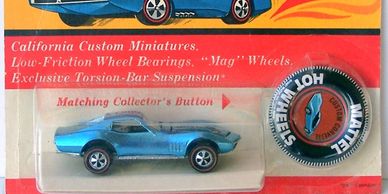
Mattel did a great job with all their packaging of Spectraflame Redlines, but there were many changes through the years. Even though some were very subtle while others were major, all were due to the constant changing of the Hot Wheels line. Because blister packs are an important part of Hot Wheels collecting, below is a summary detailing the different packaging styles Mattel used during the Spectraflame era.
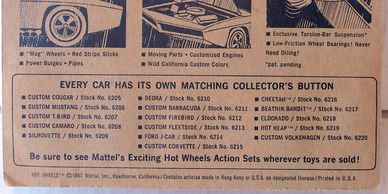
The first blister pack card which is very rare, only listed the first 10 castings Mattel produced. The “10 back card” was quickly updated to include the full line up of the original 16 castings for 1968 which included the “Cheetah.” The “Cheetah” casting was renamed to the “Python” prior to release but Mattel continued to use the “Cheetah” printed card stock in production until the card back was changed to list “Python” among the list of 16 castings. This “16 back card” is referred to as the “Cheetah card” by many collectors and is somewhat coveted due solely to the listing of the “Cheetah.”
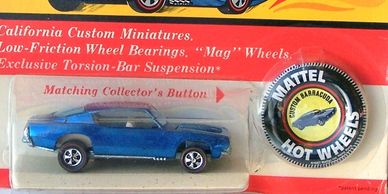
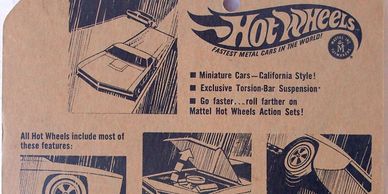
The original blisters were smooth sided and included cardboard inserts which incorporated wheel locks to protect the cars from rolling around and prevent damage to the blister itself. Packaging for the original 16 were made in both the U.S. and Hong Kong and came in different varieties. Early on, Mattel used a small punch hole that was later changed to a larger punch hole and the original logo on early production oversized blister packs were the norm for both U.S. and Hong Kong. As production ran full swing, cost cutting measures changed the style of the U.S. blisters to a more tight fitting, ribbed blister and use of the cardboard inserts was eliminated. Hong Kong packaging continued the use of the oversized blister, though many were changed to the ribbed style while continuing to use cardboard inserts with either wheel locks or rubber bands to hold the cars in place.
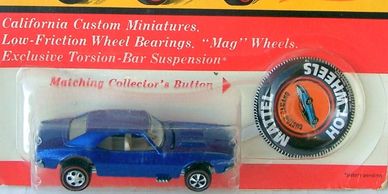
When the Spoilers series was introduced in 1970, the blister card artwork under went some color changes and included a souped up Boss Hoss on the front. Many of the early “Spoiler” castings were fitted with the smooth sided blisters with wheel lock inserts though they were phased out fairly early on in production and replaced by the ribbed sided blister with a smooth cardboard insert with the decal sheet underneath. Most probably this cardboard insert was to protect the decal sheet however there are many instances where the cardboard insert was not included. Just like the Spoilers series, the Grand Prix series, Heavyweights series and the Snake & Mongoose all have their own specially designed blister pack cards
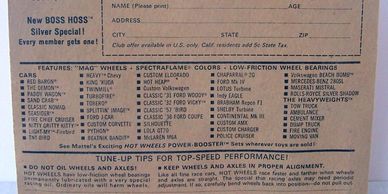
The standard Hot Wheels blister card remained the same with the exception of a few small changes during the upcoming years. In 1971, the card took on a new look with artwork of a new car appearing on the front and the phrase “California Custom Miniatures” in bold lettering appeared above the blister. This blister card is commonly referred to as the “Mantis card” due to the artwork of the “Mantis” casting adorned on the front. Around this time is also when the popular metal buttons were being phased out and plastic buttons took their place due to legal reasons. Some ’71 and most of the ’72 castings have been found in Canadian packaging on a standard style blister pack with a plastic “wheel” button. This “wheel” button looks like a generic mag wheel that resembles the front insert of the 12 and 24 car Rally carrying case. 1972 saw another noticeable change when buttons were completely removed and replaced by a double sided piece of tape to be used with the “Driving Gear” accessory which was sold separately.
Additionally, Redlines of the Spectraflame era can be found in a variety of other packaging with varying designs and styles as they were distributed to many other countries around the world. The U.K. probably had the most variety in design styles with the “Rosebud” card being the most notable. The “Rosebud” card has “Matty Mattel” wearing a crown above the letter “M” and the words “Rosebud Mattel” above and “Toymakers” below within a black seal. This is the same black seal that has just “Mattel” in white lettering across the middle on all other packaging. Other designs include the Show and Go series, Custom Car series with single and double blister versions, a European series and a Racing series. Italian blisters have the wording Brucia Pista, German has Heisse Rader and finally there is Japanese packaging which is very sought after by collectors and of course all wording is in Japanese except for the words ”Hot Wheels.”